
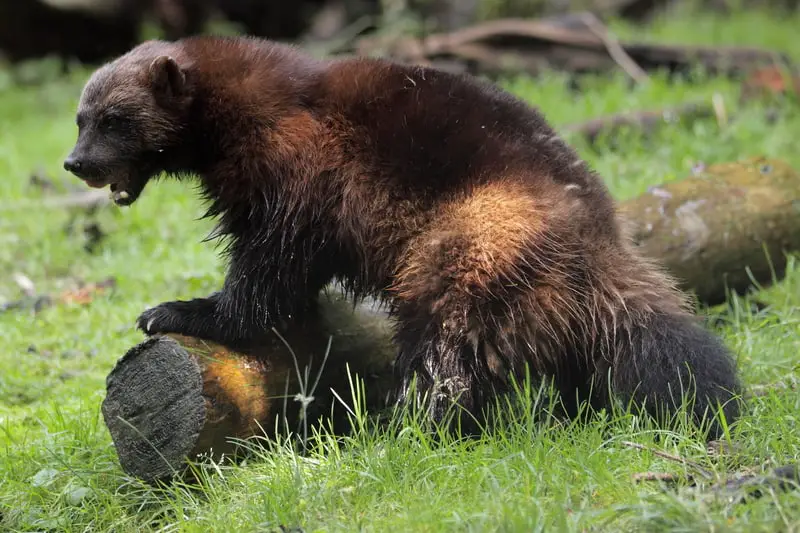
Wolverines resemble stocky miniature bears. However, they are large, fierce members of the weasel family. The scientific name for the weasel family is Mustelidae. Other members of the Mustelidae family include weasels, minks, the American badger, the honey badger, and other similar animals. The only mustelids bigger than wolverines are African clawless otters, sea otters, and the Amazon’s giant river otters. All of these are semi-aquatic. The wolverine is the world’s largest land weasel. At the other end of the size scale is the least weasel. They are the smallest members of the mustelid family.
Wolverines are members of the Gulo genus. Their scientific name is “Gulo gulo”. Gulo is Latin for glutton, giving reference to their huge appetites. They are the only extant members of the Gulo genus. However, the fossil record shows that there were several extinct members of this same genus.
Wolverine Physical Description
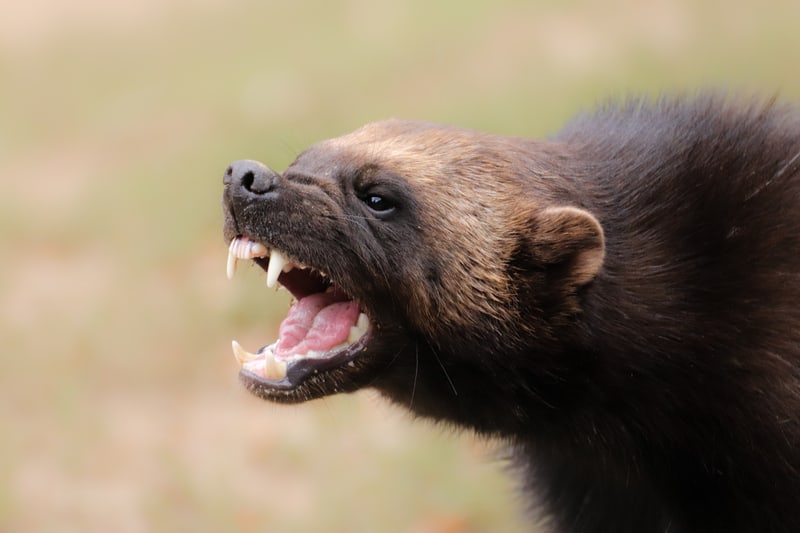
Wolverines look somewhat like a cross between a small bear and a large badger. They have a muscular, stocky build with short legs in proportion to their body size. Their five-toed feet are comparatively large, with their front feet being larger than their hind feet. On each toe, they have curved, sharp claws that are semi-retractable. They have a bushy tail that is approximately 1/5 as long as their body. Compared to other mustelids, they have a broad, thick skull, small eyes, and short, round ears. Their powerful jaws are built for crushing the bones of large prey, such as caribou and moose.
How Big is a Wolverine?
- This alpine carnivore is roughly comparable to a medium-sized dog.
- Adult wolverines stand between 14 and 18 inches (36–45 cm) tall at the shoulder.
- They range from 26 to 43 inches (65–109 cm) long.
- They weigh 24 lbs. (10.9 kg) to 39.9 lbs. (18.1 kg).
- Wolverines display significant sexual dimorphism in size. Adult males are sometimes as much as 30% larger than adult females in height and length. Additionally, an average adult male wolverine will be up to two times larger than an average adult female wolverine in weight.
Wolverine Fur / Properties / Coloration
Wolverines have tough, extremely oily, and water-resistant fur on top of a thick hide. It repels frost better than most other furs. Consequently, it is prized by the indigenous people of northern Canada, Alaska, and Siberia as a fringe lining for their gloves and especially parka hoods that insulate in extremely cold weather.
Their coloration is dark brown to almost black. Sometimes, but rarely, they are cream-colored with brownish feet. Most individuals have a lighter-colored mask above the eyes and around their face. Additionally, some individuals have white patches on their throat and chest. They also have a pale buff stripe that runs horizontally from their head, down their neck, shoulder, ribcage, and down the length of their bodies, and across their rump. This horizontal stripe ranges in color from cream-colored to pale yellow to reddish-brown.
Wolverine Senses and Adaptations
Wolverines have poor eyesight, but they compensate for this by having excellent hearing and a keen sense of smell. They can sniff out food that is lying under multiple feet of snow or even underground. Their underground food comes in the form of hibernating prey animals.
Wolverine Temperament and Behavior
Wolverines are famous for their strength and ferocity. They don’t always win the fight, but when the chips are down, they’re willing to face down almost any animal that gets in their way.
Like all mustelids, wolverines spray a nasty-smelling concoction from their anal glands. This is a rank-smelling, yellowish-brown colored musk. They use it to mark their territory or as a weapon when they’re in a fight. Consequently, one of the nicknames they’ve earned is Skunk Bear.
What Eats Wolverines? Wolverine Predators Explained
A wolverine has a voracious appetite. They are opportunistic eaters. Consequently, they quickly adapt to whatever food source is temporarily abundant. Fortunately for them, they have a keen sense of smell that alerts them to any available food in their environment. Much of the time, that is live prey. However, they will readily feed on carrion from dead animals such as winter-killed moose and caribou. They will also kill larger animals such as moose, elk, deer, and caribou if they can ambush them or the animal is stranded in deep snow.
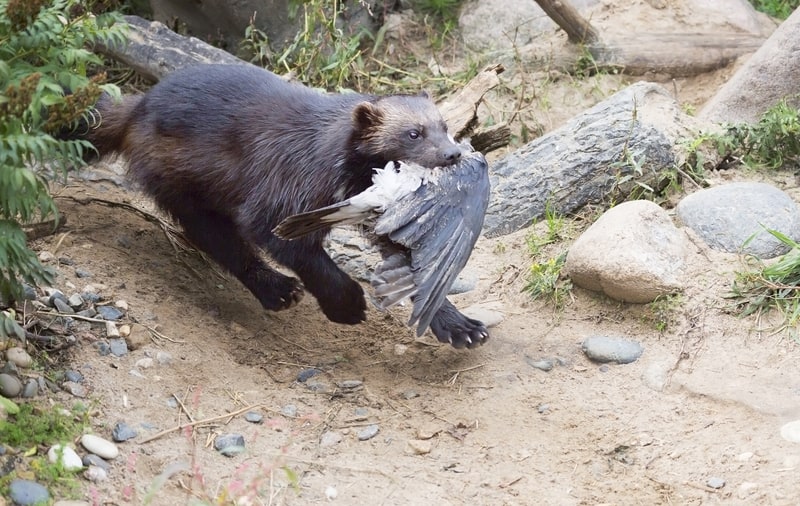
Analysis of the stomach contents of twenty Alaskan wolverines showed that caribou and moose were their most frequently consumed foods. Stomach content analysis in Norway showed that reindeer are their most important food source. On the coast of Alaska, wolverines feed at times on the carcasses of dead walruses, whales, and seals that have been washed on the beach. Wolverines also eat birds, such as ptarmigans and birds’ eggs. Additionally, they eat small animals such as snowshoe hares, porcupines, squirrels, and small rodents such as ground squirrels, mice, and voles.
How Do Wolverines Hunt?
A wolverine’s diet depends on the terrain and available game. In areas with large predators, wolverines base a large percentage of their diet on scavenging wolf and bear kills.
The Wolverine is a more efficient cold-climate predator. This is especially true when the snow is deep and soft enough that it won’t support the weight of their prey animals. They have proportionately large, snowshoe-like feet that allow them to run on top of the snow in search of food. In conditions like this, they can run down and kill large ungulates. They kill them by leaping on their back and biting through their spine or crushing their larynx with their powerful jaws.
Wolverines also stalk and kill birds, snowshoe hares, and other small mammals. They also dig into beaver lodges to get at beavers.
Wolverine Predators
After reading the long list of things wolverines eat, you might be asking yourself the question, “What eats wolverines?” Larger predators sometimes kill wolverines. Wolves, black bears, brown bears, mountain lions, and even golden eagles are capable of killing a wolverine. This is particularly true if the wolverine is young. However, wolves and bears are mainly the animals that kill and consume wolverines. Additionally, humans trap them for their fur.
Wolves are the main natural predators that actively seek out and kill wolverines. The only way a wolverine can escape a pack of wolves is to climb a tree.
If a bear kills a wolverine, it’s usually incidental to quarreling over a carcass. A good share of a wolverine’s diet consists of carrion from wolf and bear kills. Sometimes this gets the wolverine in trouble. If a bear and a wolverine cross paths, the wolverine will face the bear down. Sometimes the bear will back off, but sometimes it will kill the wolverine.
More than any of the predators that we’ve discussed, the biggest threat to wolverines is habitat loss. Individual wolverines require hundreds of square miles of undisturbed habitat in the mountainous regions of North America, northern Europe, and Asia.
Wolverine Habitat
Most wolverines live in the cold temperate, boreal forests of the world. These are located just south of the Arctic in North America, Siberia, Asia, European Russia, and Scandinavia. They also inhabit sub-alpine and alpine regions above the timberline. In the lower 48 states, good wolverine habitat includes alpine forests, sub-alpine forests, and coniferous forest regions, primarily in the Sierra, Cascade, and the Rocky Mountains.
Where Do Wolverines Live?
Global range:
- North America, Northern Europe, and Asia
Europe and Asia:
- Sweden, Norway, Finland, Russia, China, Mongolia
Canada:
- From Newfoundland west to British Columbia
United States:
- The main population is in Alaska.
- Smaller populations in Washington, Oregon, California, Idaho, Montana, and Wyoming.
- Occasional sightings in Utah, Colorado, and Michigan.
Notable case in Utah:
From a March 14th, 2022, article in KSLNews.com, in March 2022, biologists with the Utah Division of Wildlife Resources captured a wolverine responsible for killing or wounding 18 sheep in Rich County. The 28-pound male was fitted with a GPS collar and released on the north slope of the Uinta Mountains.
Wolverine Life Cycle
The majority of the time, wolverines are solitary animals. In any of the ranges that they inhabit, they have a very low population density and a low reproductive rate. These animals use very large home ranges. Male wolverines use territories that take in 270 to 380 square miles (700 to 1,000 square kilometers). They scent mark their territory boundaries and are intolerant of encroachment from other males. However, their territories may overlap with the territories of several female wolverines. Incidentally, female wolverine territories, on average, take in 115 to 230 square miles (300 to 600 square kilometers).
Wolverines are polygamous. Consequently, during their breeding season, which runs from May through August, males will mate with any female that has reached sexual maturity and whose territory intersects with their own.
Delayed Implantation
Like most members of the Mustelidae family, wolverines have delayed implantation. After breeding, the fertilized egg develops into an 8-cell blastocyst. However, the actual implantation of the embryo in the female wolverine’s uterus won’t take place until late fall or early winter. Delayed implantation allows the female to become pregnant when she is in the best possible physical condition. In years when food is scarce, some female wolverines do not become pregnant at all, even though they have successfully mated.
Gestation and Birth
Following implantation, a wolverine’s gestation period lasts 30 to 50 days. Females give birth to a litter that contains 2 to 3 kits on average, sometimes in the late winter or early spring. Their birthing den is generally a snow cave that they have excavated.
Wolverine kits weigh around 3 ounces (85.0 grams) and are around 4.75 inches (121.0 mm) long. They are born fully furred. However, their first fur is white.
Growth and Development
Young wolverines are weaned when they are 9 to 10 weeks old. Subsequently, they begin to travel with their mothers sometime in the early summer of their first year. They will be nearly fully grown and able to find their own food by September of their first year. However, they’ll remain in their natal home range until they’re at least a year old.
Wolverines reach sexual maturity at two years of age. However, most females will not breed in their second year.
The life expectancy for wolverines is 15 to 17 years.
Conclusion
Wolverines are large, fierce members of the weasel family. These powerful and resourceful alpine predators’ diet ranges from small mammals and birds to large ungulates. Their snowshoe-like feet and keen senses make them effective hunters and scavengers. Living in cold forests, alpine regions, and boreal habitats across North America, Europe, and Asia, wolverines face threats from predators to habitat loss. Protecting their vast territories ensures these solitary, fearless mustelids continue to thrive in the wild.
Related Posts:
American Pine Marten – Krebs Creek
All About Fisher Cats – Krebs Creek
The Characteristics of Fisher Cats and Pine Martens – Krebs Creek
Recent Posts
The least weasel is the world's smallest carnivore. This little predator is also the smallest member of the Mustelidae or weasel family. They are around 320 times smaller than wolverines,...
The only venomous snakes in Washington State are Northern Pacific Rattlesnakes. The Northern Pacific Rattlesnake (Crotalus oreganus oreganus) is a sub-species of the Western Rattlesnake. Anyone...